


Timeframe
31 Days
Project Type
iOS Mobile App, Health & Wellness
Role
Sole Designer, Research, UI/UX Design, Branding, Prototyping, Testing
Overview
Context
As someone passionate about self-growth, I’ve always turned to meditation and journaling—but staying consistent was hard. On the days I needed mindfulness most, I often felt too overwhelmed to engage with it. That made me wonder: if I struggle to stay consistent, how many others do too? This inspired me to create a tool that helps people stay present, track emotions, and turn mindfulness into a rewarding habit rather than a chore.
Problem Statement
If I struggle to stay consistent with mindfulness, how many others do too?
Many young professionals struggle to maintain a consistent routine when meditation, journaling, and emotional reflection are scattered across apps or hidden behind paywalls. Without a single, accessible space to reflect and recharge, users lose motivation. Fragmented stats and limited emotional insight make progress feel disconnected, making it even harder to stick with the practice long-term.
Solution
To bridge this gap, I designed a mobile app that integrates meditation, mood tracking, and journaling into one cohesive, calming experience. Built for young professionals who care about self-care but juggle busy schedules, the app offers guided and self-guided meditations, quick mood logs, streaks, and space for voice notes or journal entries. The goal is to help users slow down, reconnect with themselves, and build a more mindful daily routine in a way that feels approachable, personal, and genuinely helpful.
User Interviews
Conversations that Guided Me
Number of Participants
8 Interviewees
Methodology
1:1 interviews conducted on Microsoft Teams
Demographics
Young professionals ages 21-30
Goal
Understand how real people relate to mindfulness—and what’s stopping them from sticking with it.
Key Data & Findings
88%
of the interviewees value mindfulness, mental wellness, and self-care.
Most users practice different techniques like exercising, skin care, and listening to music to relax.
88%
of participants unwind through physical activity or some use mindfulness techniques like yoga or journaling,
Physical exercise and journaling were the top commonalities amongst users when managing stress & anxiety.
75%
understand the benefits of engaging in either self directed or guided mediations and journaling.
While most of of the interviees do not consistently meditate, most understand the benefits and prefer both self directed & guided.
Key Pain Points & Challenges
88%
of the interviewees struggled with consistency when engaging in the practices.
Struggling with a consistent practice was majority of user's issues with meditation.
75%
stated that they don't regularly engage in meditation and journaling because they don't have enough time in their day.
The reason why it is hard to stay consistent for users is because they are busy with other aspects of their lives, like work and family.
50%
get frustrated with current apps on the market that gatekeep majority of their features with paywalls.
Other apps like Headspace and Calm make you pay for majority of the features.
Competitive Analysis
Whose Already Out There?

Headspace
Calm

How We Feel

Insight Timer
In researching existing apps, I noticed each serves a specific niche: Headspace focuses on meditation, Calm on sleep, How We Feel on emotion tracking, and Insight Timer on self-guided meditation and community. No single app combines guided and self-guided meditation, emotion tracking, and journaling in a cohesive way. While Insight Timer attempts this, user feedback shows it can feel cluttered. This revealed an opportunity to design a streamlined app that brings these key features together in a more organized, approachable experience.

User Persona
An Educated, Introspective Individual
I crafted a persona from my research that represents the ideal user for the problem I’m addressing. The interviews revealed that this user deeply values their mental health but struggles to prioritize it due to a busy lifestyle. I also formulated a POV and HMW statement based on this persona.

Feature Set
Prioritizing Based on User Needs
I based my prioritization on the insights gathered from user interviews, competitive analysis, affinity map and user persona. I found that the user values both guided and self-guided meditation, as well as tracking their mental health. However, they struggle to maintain consistency—especially when key features are hidden behind paywalls. My goal was to prioritize features that support routine and save time, while including what matters most to the user and limiting paid barriers.
Must Haves
Journal integration
Smooth onboarding
Guided meditations
Meditation timer
Mood tracking
Daily reminders
Streaks
Profile creation
Privacy
Sleep tools
Paid Features
Voice notes
Affirmations recordings
Can Come Later
Intention setting
Wearable integration
Health app integration
Breath work exercises
Gamified achievements & awards
Physical journal sync
Sitemap
Structuring for User Priorities
By focusing on information architecture and prioritizing the features users care about most, I was able to determine what belonged on the homepage. This is an early idea showing how I envisioned the app’s layout and structure.

User Flows
Mapping the Experience
Onboarding
Since interviewees mentioned that lack of time is a major pain point, I designed an onboarding experience with just a few quick steps. The objective was to keep it simple while still creating a personalized experience that helps users get closer to their goals.

Starting a Meditation Session
Users can choose meditations based on attributes like situation, time of day, and duration. After each session, they’re given the option to journal about their experience and log their mood to encourage reflection.

Low-Fidelity Wireframes
Early Sketches of my Design

Touchpoints

"Today" tab
Acts like a homepage, and includes quick shortcuts such as starting a mediation and logging emotions.
"Meditation" tab
Here, you can browse meditations by category or search.
Browsing Meditations
Easy access list of the library of meditations.

Meditation Player
Start and stop the session, finish session & bookmark to save for later if needed.
Reflection
User can write to reflect and log how they feel after the session.
Reward System
Updates the user on their streak to motivate them to keep going.
Mid-Fidelity Wireframes
Switching to Digital
Touchpoints

Including easy 'Sign up with" options for a quick account creation.

Onboarding questions for a more personalized experience.

After account creation, a personalized homepage is the first screen the user sees.

Quickly find a meditation through search or categories.


Array layout of a variety of meditations when selecting a category.
View meditation description, option to save for later.
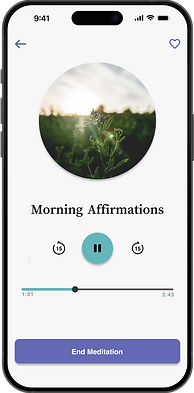
Meditation player to show length progress, able to skip ahead or rewind and 'like' the mediation.
Reflect on the meditation, ability to record voice notes and add pictures.

Log mood from a variety of emotions and save the session.
User Testing
Testing the Mid-Fidelity Flows
I aimed to test how well the mid-fidelity wireframes supported core tasks like onboarding and starting/finishing a meditation session.
Number of Participants
6 participants
Methodology
Remote test on Lysnna.
Success Rate
Demographics
Young professionals ages 21-30
Goal
-
Measure success and efficiency of both flows by user completion
100%
Feedback
Time-Saving Suggestions
Making the options to skip more obvious in the onboarding to save more time for the user.
Button Visibility
Design buttons to stand out more by making them more defined.
More Progress Updates
Emphasize on the dashboard that the user has completed their session for the day when finished.
UI Component Library
Picking Color & Typography
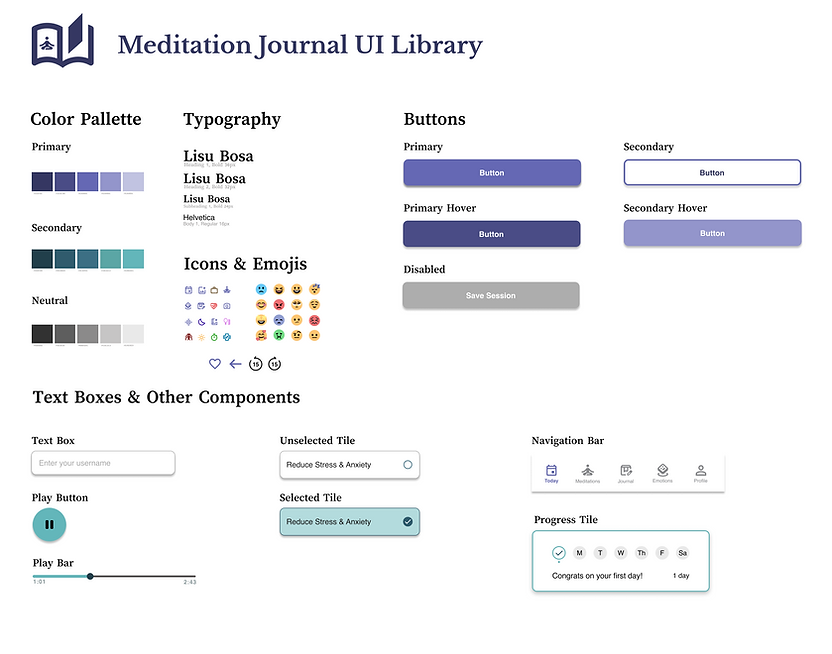
Calming Colors
Soft purple and minty teal balance calm and freshness, while meeting accessibility standards.
Elegant Font
'Lisu Bosa' adds warmth, helping the app feel more personal and inviting for journaling.
Playful UI
Emojis make mood logging simple and approachable, encouraging conssitent emotional check-ins.
High-Fidelity Prototype
Look & Feel, Upgraded


Sign-up Screen

'Today' Tab
Session Player

Profile Photo

Meditations

Journaling
Touchpoints

Personalization

Selection Array

Mood Logging

Reminders

Description

Achievements

Progress Update
Usability Testing
Testing the High Fidelity Prototype
Number of Participants
10 participants
Methodology
Remote test on Lysnna.
Success Rate
Demographics
Young professionals ages 21-30
Goal
-
Measure success and efficiency of both flows by user completion
-
Gain feedback to make iterations.
100%
Iterations
Feedback Driven Changes
Simplifying Navigation
Many users clicked on the ‘Recommended Meditation’ feature within the ‘Today’ tab, even though it wasn’t originally integrated into the intended user flow. While this slightly impacted the findings, it highlighted a clear user preference for guided suggestions to access content more efficiently.


Improving Contrast
I enhanced accessibility by increasing the visibility of disabled buttons, while maintaining clear visual cues to indicate their inactive state.

Before

After
Conclusion
Closing Reflections
Designing the Meditation Journal allowed me to tackle a meaningful problem rooted in both personal experience and real user needs. In a world where people are constantly balancing stress, goals, and self-improvement, many feel pulled in too many directions to stay consistent with mindfulness. Through user research, competitive analysis, and testing, I uncovered a major gap: no single tool offered meditation, journaling, and emotional tracking in one cohesive, motivating experience.
By designing an app that integrates all three—with flexibility, ease of use, and minimal paywalls—Meditation Journal helps users build a sustainable practice that fits their lifestyle. This product has the potential to make mental wellness more accessible, more human, and more integrated into everyday life—not just another app to open, but a companion for growth. I hope it puts people on the path to self improvement or to feel motivated to better themselves.
As the sole designer on this 31-day sprint, I wore many hats—from researcher to interaction designer to usability tester. But most importantly, I built something that solves a real need and has the potential to help people show up for themselves, one mindful moment at a time.